DDR5 is the latest mainstream evolution of double data rate memory. It is designed to move more data per second while improving memory capacity and power efficiency. According to the JEDEC JESD79-5B standard, DDR5 begins at 4,800 MT/s, while DDR4 commonly reaches 3,200 MT/s. That difference gives DDR5 substantially higher theoretical bandwidth. In simple terms, more data can travel between the processor and memory during each second.
The answer to “Why DDR5 is faster than DDR4” involves more than clock speed. A DDR5 module uses two independent 32-bit subchannels, compared with DDR4’s single 64-bit channel. This structure can improve access efficiency, especially when a processor handles several tasks simultaneously. DDR5 also adds higher bank counts, improved command scheduling, and on-die error correction. Micron’s DDR5 SDRAM technical brief identifies these architectural changes as key improvements for modern computing platforms. Its standard operating voltage is also lower, at 1.1 volts compared with DDR4’s typical 1.2 volts.
The picture is not perfectly simple. Higher bandwidth does not always produce faster applications. Real performance depends on the processor, timings, workload, and software design. Some games may show modest gains, while memory-heavy rendering or data analysis can benefit more clearly. Intel’s platform documentation also stresses that supported memory speeds depend on the processor and motherboard. That caveat matters. DDR5 can feel like opening a wider highway, but traffic still depends on the road system. This article examines the specifications, practical benchmarks, and limitations behind DDR5’s advantage over DDR4.
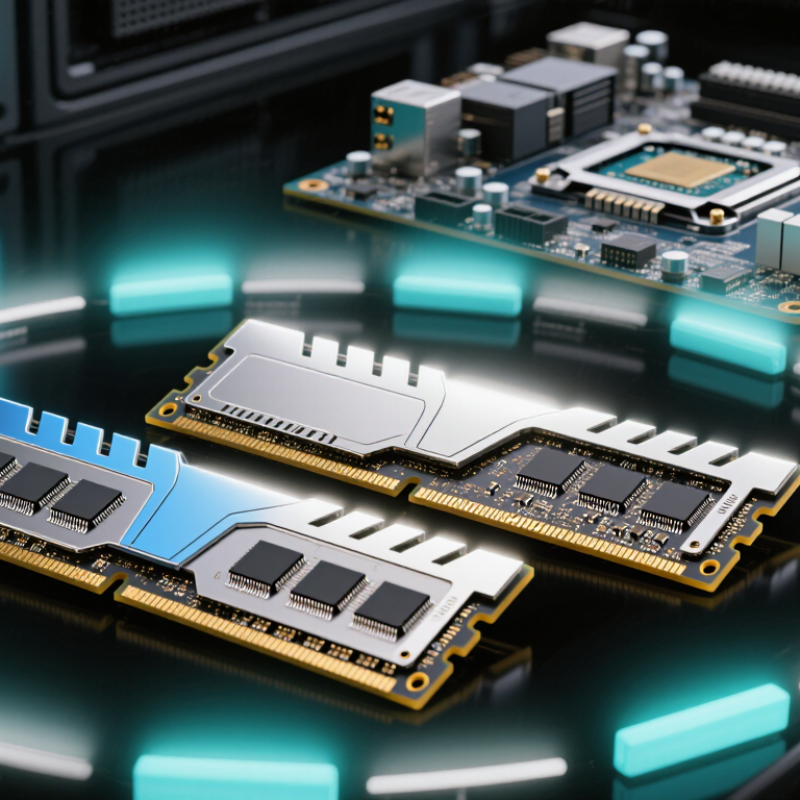
DDR5 and DDR4: Definitions and Core Memory Functions
Dynamic random-access memory stores temporary data for the processor. It loses information when power disappears. DDR means Double Data Rate, because memory transfers data twice during each clock cycle. DDR4 commonly operates from 1,600 to 3,200 megatransfers per second (MT/s). The JEDEC JESD79-5 standard defines DDR5 starting at 3,200 MT/s and extending to 6,400 MT/s. Higher transfer rates move more data through the same short processing window.
The comparison is not perfectly simple. Speed depends on latency, memory channels, firmware, and workload. DDR5 divides a memory module into two independent 32-bit subchannels. This design improves access efficiency, especially when several tasks compete for data. DDR5 also supports on-die error correction, but this does not replace system-level ECC. It helps correct internal chip errors.
Capacity has changed too. JEDEC’s DDR5 specification supports individual memory devices up to 64 gigabits, compared with 16 gigabits for DDR4. That difference allows larger modules and denser servers. Industry analysis from TrendForce in 2024 linked DDR5 adoption with growing server and artificial-intelligence workloads. Those workloads repeatedly move large datasets. In practical testing, however, gains can vary sharply. A bandwidth-heavy task may respond immediately, while an office application may feel almost unchanged. DDR5 is faster on paper, but real performance still needs balanced system design.
| Comparison Dimension | DDR4 | DDR5 | Why It Matters |
|---|---|---|---|
| Definition | A fourth-generation double-data-rate synchronous dynamic random-access memory standard. | A fifth-generation double-data-rate synchronous dynamic random-access memory standard. | Both technologies provide temporary, high-speed working memory for processors and other components. |
| Primary Function | Stores actively used data and instructions so the processor can access them quickly. | Performs the same core function with greater bandwidth scalability and improved memory-subsystem efficiency. | More available memory bandwidth can help data-intensive workloads move information faster. |
| Standard Data-Rate Range | Commonly specified from 1,600 to 3,200 MT/s. | Introduced with standard speeds from 3,200 to 6,400 MT/s. | MT/s means million transfers per second. Higher transfer rates increase theoretical bandwidth. |
| Theoretical Bandwidth per 64-Bit Memory Channel | Approximately 12.8 to 25.6 GB/s, depending on the data rate. | Approximately 25.6 to 51.2 GB/s, depending on the data rate. | DDR5 can provide up to twice the bandwidth of the initial DDR4 speed range under comparable channel conditions. |
| Nominal I/O Voltage | Approximately 1.2 V. | Approximately 1.1 V. | The lower nominal voltage can improve energy efficiency per transfer, although total system power depends on capacity, speed, and workload. |
| Prefetch Length | 8n prefetch. | 16n prefetch. | DDR5 transfers more internal data per memory access, helping support higher external data rates. |
| Burst Length | Typically BL8. | Typically BL16, with support for shorter burst operation through burst chop. | Longer bursts improve the efficiency of sequential data transfers. |
| DIMM Channel Organization | One 64-bit data channel per standard non-ECC module. | Two independent 32-bit data subchannels per standard module, totaling 64 data bits. | Independent subchannels can improve command scheduling and reduce the impact of small or non-sequential requests. |
| Bank Organization | Typically 4 bank groups with 4 banks per group. | Typically 8 bank groups with 4 banks per group. | More bank groups provide more opportunities for parallel memory operations. |
| On-Die ECC | Not included as a standard feature inside the memory chips. | Includes on-die error correction within each memory chip. | On-die ECC helps correct certain internal memory-cell errors, but it is not the same as full system-level ECC memory. |
| Power Management | Memory-module voltage regulation is generally handled by the platform or motherboard. | Uses a power-management integrated circuit on the memory module. | Module-level power management can improve voltage regulation and power-delivery control. |
| Latency Consideration | Often available with lower absolute access latency at comparable mainstream configurations. | May have similar or higher absolute latency in some configurations, despite higher bandwidth. | DDR5 is not automatically faster in every task; its main advantage is higher bandwidth and greater scalability. |
| Compatibility | Requires a DDR4-compatible memory controller and motherboard slot. | Requires a DDR5-compatible memory controller and motherboard slot. | DDR4 and DDR5 modules are electrically and physically different and cannot be used interchangeably. |
DDR is temporary computer memory. It transfers data twice during each clock cycle. Power loss clears its stored information.
DDR5 supports higher transfer rates and moves more data per second. DDR4 commonly reaches 3,200 MT/s, while DDR5 can reach 6,400 MT/s.
No. Processor design, latency, firmware, and workload also affect performance. Browsing may feel nearly unchanged.
Video editing, 3D rendering, scientific work, and modern games may improve. Large datasets can move more smoothly between memory and the processor.
DDR4 uses one 64-bit channel. DDR5 divides a module into two independent 32-bit subchannels.
DDR5 normally operates at 1.1 volts. DDR4 commonly operates at 1.2 volts. Lower voltage can reduce memory power use.
DDR5 includes on-die error correction for some internal chip errors. It does not replace full system-level ECC.
Usually not. They use different electrical layouts and physical designs. A DDR5 module will not fit a DDR4 slot correctly.
Check the motherboard manual, processor support, firmware, and speed limits. A motherboard replacement may cost more than expected.
Not necessarily. Memory-heavy work may show clear gains, while simple office tasks may not. I once treated speed as everything. That was too simple.
DDR5 and DDR4 are generations of synchronous dynamic random-access memory designed to temporarily store data for quick access by a computer’s processor. While both perform the same core function, DDR5 introduces a more advanced hardware design, including improved internal organization and separate memory channels within each module. These changes help the system handle data more efficiently and support higher memory capacities.
Why DDR5 is faster than DDR4 is mainly explained by its higher transfer rates and greater memory bandwidth. DDR5 can move more data per second, reducing delays during demanding tasks such as content creation, large-scale multitasking, and modern gaming. It also operates with improved power efficiency and uses an updated power-management approach. However, performance gains depend on the processor, motherboard, software, and workload. DDR5 is not backward compatible with DDR4, so upgrading generally requires a suitable motherboard and compatible system components.

 Vorynex