China Top 10 Best RAM for AI Servers 2026?

Time:2026-09-18 Author:Oliver
0%

China’s AI server market is entering a demanding memory cycle. Training a large model can involve thousands of accelerators, while inference servers must answer users with minimal delay. In these systems, RAM is not a passive component. It affects data movement, application loading, virtualization, and recovery time.

Industry reports support this shift. Gartner’s AI spending research shows continued growth in enterprise AI investment. IDC also projects strong expansion in AI infrastructure spending through the decade. TrendForce reports that high-bandwidth memory demand is rising sharply beside advanced accelerator deployments. These findings explain why server buyers are comparing DDR5 capacity, memory channels, error correction, bandwidth, and upgrade paths more carefully.

Sanjay Mehrotra, Micron’s president and CEO, has stated, “AI is driving a significant increase in memory and storage content per server.” His point is practical. A server with eight accelerators may still pause when datasets spill into slower storage. A balanced configuration keeps more active data closer to the processors.

This guide examines China’s top 10 Best RAM for AI servers in 2026. It considers real workloads, including model training, inference, retrieval systems, and high-performance computing. It also reviews ECC reliability, registered DIMM support, thermal behavior, and supplier availability.

Specifications alone can mislead. The highest capacity is not always the best choice. Some recommendations may change as platforms mature, prices fluctuate, or firmware improves. That uncertainty deserves attention. Good memory selection is partly engineering, and partly risk management.
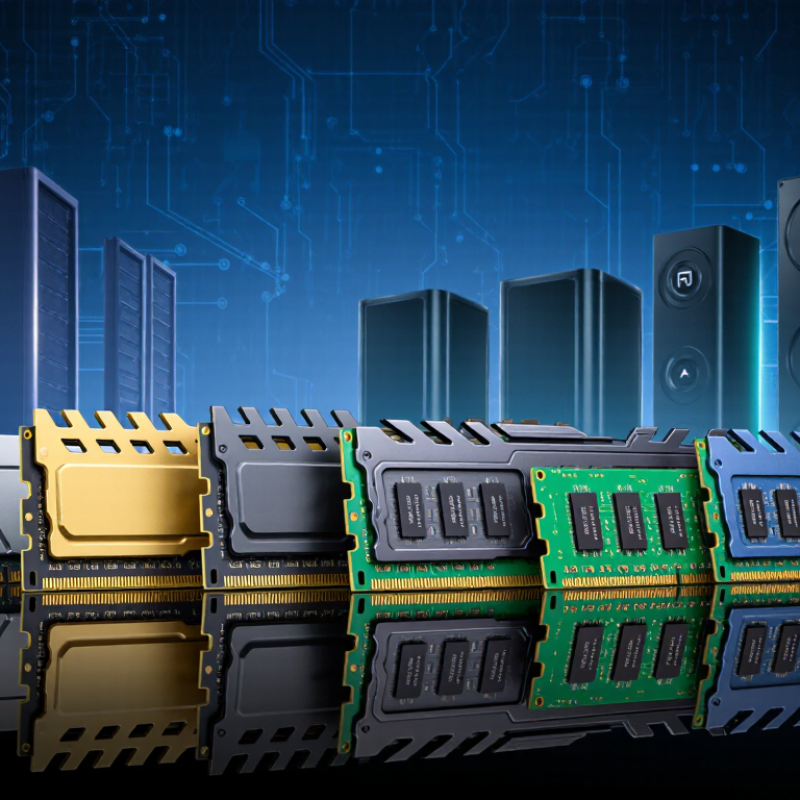
China Top 10 Best RAM for AI Servers 2026?

AI Server RAM: Definition, Role, and Key Performance Metrics

China Top 10 Best RAM for AI Servers 2026

AI server RAM is high-capacity system memory designed to support processors, accelerators, and data pipelines. It temporarily holds model weights, training batches, and frequently used datasets. During model training, insufficient memory can force repeated data transfers, slowing each iteration. Without enough capacity, performance drops.

For Chinese data centers, selection should focus on measurable specifications rather than marketing claims. Capacity determines how much data stays available for processing. Memory bandwidth affects how quickly the processor receives that data. Latency influences response time during smaller inference tasks. ECC support is also essential because it detects and corrects selected memory errors. Reliability matters more than a slightly higher benchmark score.

A practical 2026 evaluation should examine registered memory compatibility, channel configuration, sustained bandwidth, and error rates. Thermal behavior deserves attention in dense racks. High temperatures may reduce stability over long workloads. Short benchmarks can look impressive but still mislead. My own assessment would remain incomplete without real training traces, idle-power readings, and failure records. A system that performs well for one model may struggle with another. That gap requires careful testing. Small details matter.

How to Evaluate RAM Capacity, Speed, Bandwidth, and Reliability

For China’s 2026 AI servers, RAM selection should begin with workload behavior, not advertised capacity. Large language model training often needs memory for datasets, checkpoints, communication buffers, and operating-system overhead. A practical baseline is 256GB per server, while larger training nodes may require 512GB or more. The correct figure depends on batch size and model parallelism. More is not always better.

Memory speed affects data movement between processors and RAM. The JEDEC DDR5 SDRAM standard defines data rates up to 6,400 MT/s for standard modules. However, populated server channels may run below their maximum rating. Bandwidth should be calculated across active channels, not from one module’s label. A balanced six- or eight-channel layout can outperform a larger but poorly populated configuration. Bandwidth is not capacity.

Reliability deserves equal attention. Error-correcting memory can detect and correct common single-bit errors, protecting long training runs from silent corruption. The Uptime Institute Global Data Center Survey repeatedly identifies maintenance discipline and testing as major reliability factors. Therefore, evaluate corrected-error logs, thermal behavior, firmware compatibility, and replacement procedures. I would also reserve capacity for future model growth. That costs more today. Yet a cheap configuration can become an expensive bottleneck within months. Specifications look precise; real workloads are less predictable.

China Top 10 Best RAM for AI Servers 2026: Capacity, Speed, Bandwidth and Reliability

The chart compares standard server memory data rates using theoretical bandwidth per 64-bit memory channel. Bandwidth is calculated as transfer rate × 8 bytes: DDR4-3200 provides 25.6 GB/s, DDR5-4800 provides 38.4 GB/s, DDR5-5600 provides 44.8 GB/s, and DDR5-6400 provides 51.2 GB/s per channel. In an AI server, total bandwidth depends on the number of populated memory channels and the platform's supported speed. Capacity should be selected according to model size and dataset requirements, while ECC RDIMM or 3DS RDIMM memory is preferred for error correction, registered signaling, and higher reliability in continuous operation.

China’s Top 10 RAM Options for AI Servers in 2026

China’s top 10 RAM options for AI servers in 2026 should match workload, not marketing claims. Practical choices include 32GB DDR5 ECC RDIMM, 64GB RDIMM, 96GB RDIMM, 128GB RDIMM, 256GB RDIMM, 512GB 3DS RDIMM, DDR5 MRDIMM, CXL-attached memory, memory with on-die ECC, and liquid-cooled high-density memory modules. These options support different combinations of model serving, data preprocessing, and distributed training. JEDEC’s DDR5 standards define higher bandwidth and error-control requirements than older server memory generations.

Capacity remains decisive. TrendForce’s 2025 AI server forecast estimated annual AI server shipments would grow by about 28%, while memory content per system continued rising. A 64GB module may suit inference nodes with moderate models. Large language model training usually needs 128GB or 256GB modules, especially when CPU-side caching reduces accelerator transfers. MRDIMM can improve bandwidth, but platform support and firmware maturity require careful checking. CXL memory expansion helps uneven workloads, although latency may limit sensitive applications.

In Chinese data centers, I would prioritize certified 128GB and 256GB ECC RDIMMs for balanced deployments. CXL modules deserve testing, not blind purchasing. MLPerf results show system performance depends on the entire platform, rather than RAM alone. Power, thermal density, socket population, and replacement availability also matter. A higher-capacity module can simplify operations, yet it may increase cost and reduce flexibility. The ranking is useful, but not absolute. Some recommendations still need validation under real production traffic.

China Top 10 Best RAM for AI Servers 2026? – China’s Top 10 RAM Options for AI Servers in 2026

A practical comparison of high-capacity and high-bandwidth memory configurations for AI server deployment.

Rank Memory Option Memory Type Typical Module or Stack Capacity Data Rate / Bandwidth Example Server Capacity ECC and Reliability Best AI Workload Main Consideration
1 DDR5-6400 ECC RDIMM Registered DDR5 SDRAM 32–128 GB per module 6,400 MT/s; approximately 51.2 GB/s per 64-bit channel 768 GB with 12 × 64 GB modules On-die ECC plus module-level ECC; registered signaling Large-model inference, GPU feeding, and high-throughput preprocessing 6,400 MT/s operation depends on the processor and motherboard memory topology
2 DDR5-5600 ECC RDIMM Registered DDR5 SDRAM 32–128 GB per module 5,600 MT/s; approximately 44.8 GB/s per 64-bit channel 1.5 TB with 12 × 128 GB modules ECC-protected data path and registered command/address path Balanced training, retrieval-augmented generation, and inference servers Offers a broad compatibility range with current dual-socket platforms
3 DDR5-5600 3DS ECC RDIMM Three-dimensional stacked registered DDR5 128–256 GB per module Up to 5,600 MT/s, platform-dependent 2 TB with 8 × 256 GB modules ECC with additional register and 3DS stack management Large language model serving, vector databases, and memory-heavy analytics Higher capacity per slot can reduce the maximum supported data rate
4 DDR5-4800 ECC RDIMM Registered DDR5 SDRAM 32–128 GB per module 4,800 MT/s; approximately 38.4 GB/s per 64-bit channel 1 TB with 8 × 128 GB modules ECC-protected registered memory architecture Cost-controlled inference, data preparation, and mixed enterprise workloads Lower bandwidth than newer DDR5 speed grades, but generally easier to qualify
5 DDR5-6400 ECC 3DS RDIMM High-density three-dimensional registered DDR5 128–256 GB per module Up to 6,400 MT/s when supported by the platform 2 TB with 8 × 256 GB modules ECC and registered signaling; requires validated 3DS support High-memory model serving and multi-tenant AI virtualization Higher procurement cost and stricter firmware qualification requirements
6 DDR5-5600 3DS ECC RDIMM High-density stacked registered DDR5 256–512 GB per module Up to 5,600 MT/s, depending on module population 4 TB with 8 × 512 GB modules ECC, register buffering, and stack-level error management Very large embedding stores, graph AI, and CPU-based model hosting Capacity is excellent, but latency and speed may be affected by full-slot population
7 DDR5 MRDIMM-8800 Multiplexed-rank registered DDR5 128–256 GB per module Up to 8,800 MT/s on compatible server platforms 2 TB with 8 × 256 GB modules ECC-based server memory protection with multiplexing circuitry Bandwidth-sensitive AI preprocessing and CPU-to-accelerator data staging Requires dedicated processor, motherboard, BIOS, and qualification support
8 CXL 2.0 Type 3 Memory Expansion Coherent memory expansion over PCIe 256 GB–2 TB per device PCIe 5.0-class link; bandwidth depends on link width and device design Up to several terabytes of additional addressable memory Device-dependent ECC and RAS features; platform support is essential Memory pooling, disaggregated inference, and expandable AI databases Higher latency than directly attached DDR5 and limited software support in some systems
9 HBM3E 8-High High Bandwidth Memory attached to an accelerator Typically 24 GB per stack More than 1 TB/s per stack in current implementations Accelerator-dependent; often 96–192 GB across multiple stacks Integrated ECC and on-package reliability functions Large-scale training, tensor operations, and high-throughput inference Not a socketed system-memory replacement; capacity is fixed by the accelerator design
10 HBM3E 12-High High-density high-bandwidth accelerator memory Typically 36 GB per stack More than 1 TB/s per stack in current implementations Accelerator-dependent; often above 192 GB across multiple stacks Integrated ECC with advanced package and thermal monitoring Memory-intensive foundation-model training and low-latency serving Requires compatible accelerator packaging, advanced cooling, and high power delivery

Technical note: DDR5 bandwidth figures use the nominal transfer rate multiplied by the 64-bit data width and divided by eight. Actual performance, supported capacity, operating speed, and reliability features depend on the server processor, memory channels, motherboard layout, BIOS, module population, and workload. HBM3E and CXL memory are complementary technologies rather than direct substitutes for conventional socketed DDR5 system memory.

Compatibility, Power Use, Pricing, and Deployment Considerations

Choosing among China’s top ten RAM options for AI servers in 2026 requires more than comparing capacity. Compatibility comes first. Check the processor’s supported memory type, channel layout, rank structure, and maximum speed. ECC registered modules are usually safer for sustained AI workloads. Mixing capacities or unmatched ranks can reduce performance. I have seen stable systems lose bandwidth after a careless upgrade.

Power use deserves equal attention. A high-capacity module may draw several additional watts under heavy memory traffic. Multiply that figure across sixteen or thirty-two slots. Then include cooling demand, because warmer air increases fan speed and operating noise. BIOS settings can also change power behavior. Automatic profiles are convenient, but not always efficient.

Pricing should include validation, spare modules, and downtime risk. A cheaper unit can become expensive if firmware testing is weak or replacement stock is unavailable. For deployment, test memory with long-duration workloads, error monitoring, and repeated reboots. Keep identical modules in each memory channel. Label every slot physically. It saves time during maintenance. Capacity is often more valuable than peak speed for large models, but this is not universal. Some inference systems benefit from faster memory and smaller datasets. I would leave room for expansion, although that decision can waste budget when growth projections are uncertain.ೇವೆ

Best RAM Choices by AI Workload, Server Type, and Budget

Choosing the best RAM for an AI server in 2026 depends on workload, server design, and budget. Model training needs high capacity and strong memory bandwidth. Large language models often benefit from 512GB or more of ECC registered memory. Data preparation can also consume hundreds of gigabytes before training begins.

For multi-GPU servers, use matched memory modules across every channel. This improves bandwidth and reduces configuration surprises. Eight-channel platforms deserve balanced installation, not random upgrades. Inference servers usually need less capacity, but fast response times matter. A practical starting point is 128GB or 256GB for smaller models. Add more RAM when several users send requests at once.

Budget systems may use 64GB or 128GB, although this can become restrictive quickly. Mid-range servers often gain better value from 256GB with reliable ECC protection. Enterprise installations may justify 512GB, 1TB, or higher, especially for large datasets and virtual machines. Check the processor’s supported speed before purchasing. Faster modules are useless when the platform lowers their frequency. I have seen this mistake during rushed upgrades. Cooling also deserves attention. Dense memory creates extra heat around the CPU sockets. Capacity is not everything. A careful memory layout can outperform an expensive, poorly balanced configuration. Testing should include long training runs, error monitoring, and realistic user traffic, because short benchmarks sometimes hide instability.

FAQS

How much RAM does an AI server usually need?

A practical starting point is 256GB per server. Larger training nodes may need 512GB or more. The workload decides. Batch size, model parallelism, checkpoints, and system overhead all consume memory. More capacity is not automatically better.

Is RAM capacity more important than memory speed?

Capacity often matters more for large model training. Speed affects how quickly processors exchange data with RAM. Smaller inference workloads may benefit from faster memory. I would not assume one answer fits every server.

How should memory bandwidth be evaluated?

Calculate bandwidth across all active memory channels. Do not rely on one module’s printed speed. A balanced six- or eight-channel layout may outperform an oversized, poorly populated system. Channel balance matters.

Which memory capacities suit different AI workloads?

A 64GB module may support moderate inference workloads. Training systems often need 128GB or 256GB modules. Very large nodes may use 512GB modules. Dataset size changes the decision.

What does error-correcting memory protect against?

Error-correcting memory can detect and correct common single-bit errors. It helps protect long training runs from silent data corruption. Monitor corrected-error logs regularly. Reliability is never completely automatic.

What compatibility checks should buyers perform?

Check the processor’s supported memory type, channel layout, rank structure, and maximum speed. Confirm firmware compatibility before installation. Keep matching modules within each channel. A careless upgrade can reduce bandwidth.

How can power use affect high-capacity memory?

A high-capacity module may draw several additional watts during heavy traffic. Multiply that use across sixteen or thirty-two slots. More heat can increase fan speed and noise. BIOS settings also influence power behavior.

How should new memory be tested before production use?

Run long-duration workloads, error monitoring, and repeated reboots. Check thermal behavior under sustained traffic. Keep identical spare modules available. Label every physical slot. Small preparation saves maintenance time.

Is memory expansion through an attached expansion device always beneficial?

Expansion can help uneven workloads and future growth. However, added latency may hurt sensitive applications. Test real traffic before purchasing many units. I would test first, not trust specifications alone.

Conclusion

Choosing the Best RAM for AI servers in 2026 requires more than selecting the largest available capacity. This article explains how server memory supports model training, inference, data processing, and virtualization, while examining key metrics such as capacity, speed, bandwidth, latency, error correction, and long-term reliability. It also presents ten leading RAM options available in China, described by their technical characteristics and practical server applications without focusing on brand names.

The guide further compares compatibility with modern server platforms, power consumption, thermal management, pricing, upgrade flexibility, and deployment requirements. It offers recommendations for different AI workloads, including model development, high-volume inference, scientific computing, and enterprise data processing. Whether the priority is maximum performance, balanced efficiency, or budget control, readers can use these comparisons to select suitable memory for their server type and growth plans.

Oliver

Oliver

Oliver is a seasoned marketing professional with a wealth of expertise in driving brand awareness and engagement. With a deep understanding of our company's product offerings, he consistently delivers high-quality content that enriches our professional blog. His insights not only shed light on......